It started, as most of my rabbit holes do, with something already running in the background. The NerdMiner v2 — my tiny ESP32 solo Bitcoin miner — has been sitting on the shelf doing its thing. One thousand and eight kilohashes per second pointed at a network running at six hundred exahashes per second. The odds are genuinely absurd. I wrote about why I’m running it anyway in the previous post.
Looking at it this afternoon got me thinking. I’ve done this before. Not with an ESP32 — with actual dedicated hardware. A long time ago.
The Parts Box
I keep a parts box. Anyone who’s been running a home lab for more than a few years ends up with one — a graveyard of adapters, cards, cables, and things that seemed worth keeping at the time. I dug it out.
Sitting in there, underneath a tangle of jumper wires and a PCI ethernet card I’ll never use, were three USB ASIC miners. Bitmain Antminers — the old USB stick kind from around 2013 or 2014. One with a red lid, one black, one silver brushed metal. U1 or U2 era. About one and a half to two gigahashes per second each.
I recognised them immediately. These things mined Bitcoin. My Bitcoin. Over a decade ago.
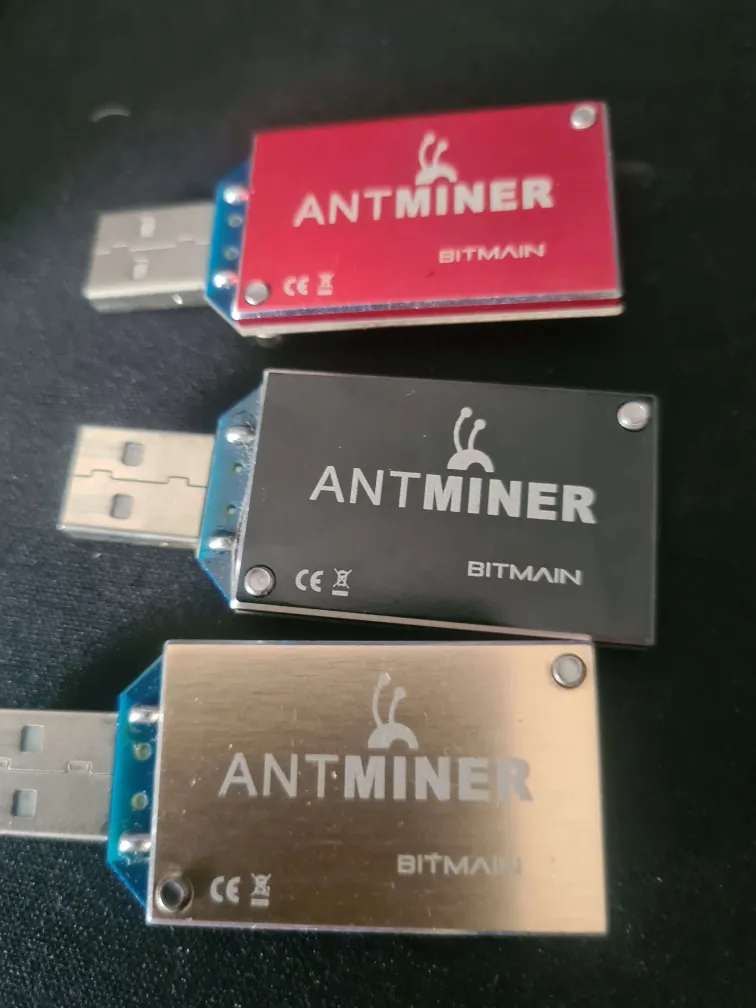 Red, black, silver. All three. Still in the box.
Finding the Wallet
Finding the hardware meant one thing: somewhere, there was a wallet. A Bitcoin Core wallet from 2014, sitting on a drive I’d kept but not thought about in years.
I found it. The wallet.dat file, from what was almost certainly the same period as those three USB sticks. Getting into it turned out to be more interesting than expected.
Bitcoin Core has moved on since 2014. The wallet had been automatically migrated to the newer descriptor format when I ran it under a modern version of Core. The old dumpwallet command — the one everyone used to use to export keys — was removed for descriptor wallets in Core 26. Running it just returned an error.
The fix was listdescriptors true, which works with the new wallet format and gives you everything you need. Then listaddressgroupings to get the addresses. Four came back, all with labels I’d apparently given them at the time: Mining 1, Mining 2, and a couple of others.
What the Blockchain Said
I checked them on mempool.space. Most had nothing. One of them — the main mining address — had a history.
It had received just over one Bitcoin. Multiple mining rewards, paid out across 2014. The timestamps lined up perfectly with when I would have been running those USB sticks. The address had seen real transactions, real block rewards, back when the network was small enough that hardware like this could actually find one.
All of it had been spent. Long ago. I know I spent it — I remember cashing some out. What’s left is dust. A few pounds worth across two addresses, nowhere near enough to justify the transaction fees to move it.
But that wasn’t really the point of looking.
The Full Circle Bit
There’s something strange about holding a piece of hardware that earned Bitcoin in 2014 while a newer, tinier piece of hardware is doing the same thing on the shelf right now. The odds are incomparably worse. The network has grown by orders of magnitude. The USB sticks would be completely useless against the modern difficulty — their combined hashrate rounds to zero.
But the NerdMiner runs anyway, and now the Antminers are out of the box. The plan is to get all three of them running again alongside the NerdMiner — a proper little swarm. BFGMiner on the Kali box to drive the ASICs, a custom dashboard to aggregate everything. I’m calling it the Mining Swarm Dashboard. It’s blocked on a powered USB hub for now — the ASICs pull too much current for a standard port.
Once the hub arrives, I’ll write it up properly. For now, the hardware is out of the box, catalogued, and waiting.
Sometimes the lab gives you a project. Sometimes it gives you a memory. Today it gave me both.